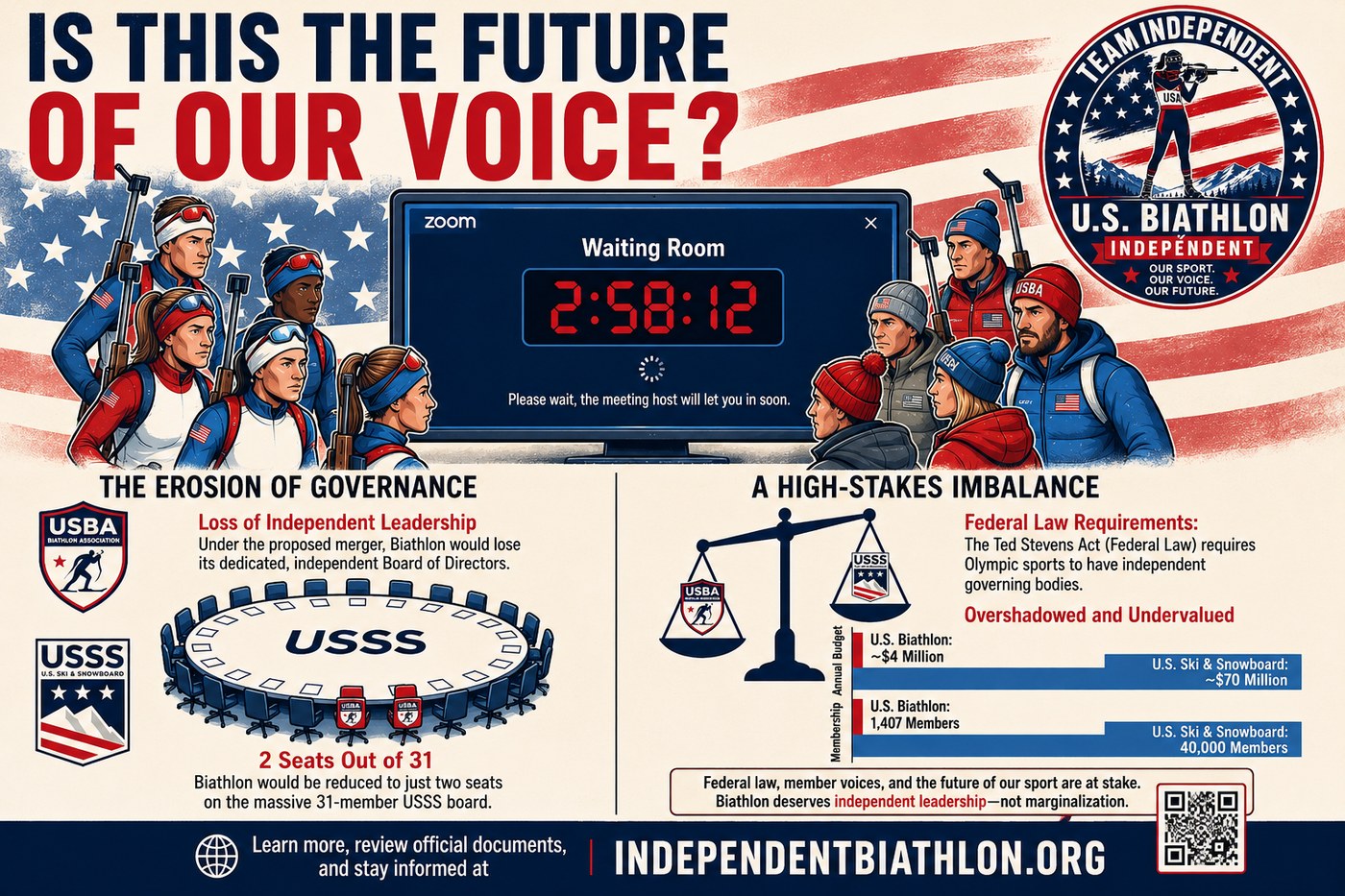
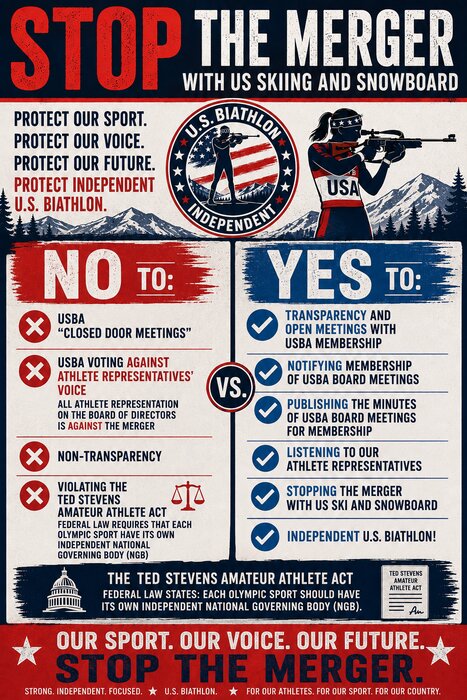
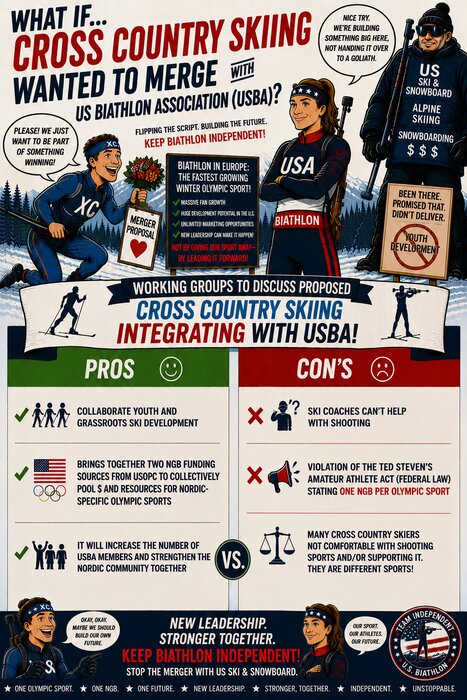
Protecting Biathlon's independent status as an Olympic sport from a prohibited merger with U.S. Skiing and Snowboarding (USSS), in violation of federal law and USOPC bylaws.
Formed by concerned USBA members Ed Williams, Art Stegen, and Joan Guetschow Wilder to educate USBA membership on the proposed loss of its NGB status.
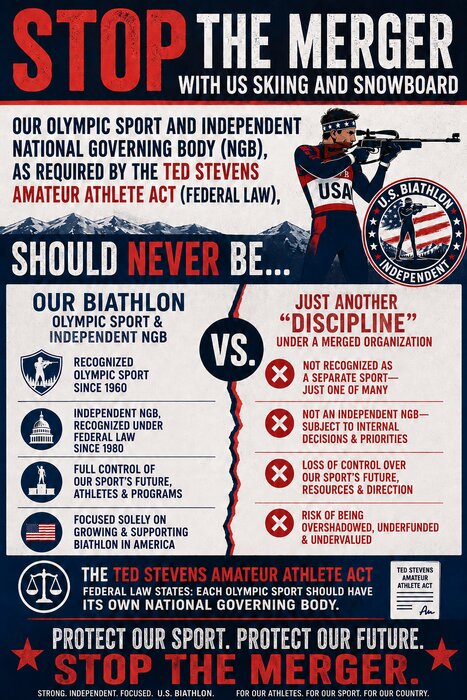
FEDERAL LAW
Federal law (36 U.S.C. §220522(6)) requires that a national governing body:
"demonstrates that it is a member of no more than one international sports federation that governs a sport included on the program of the Olympic Games, the Paralympic Games, the Pan-American Games, or the Parapan American Games."
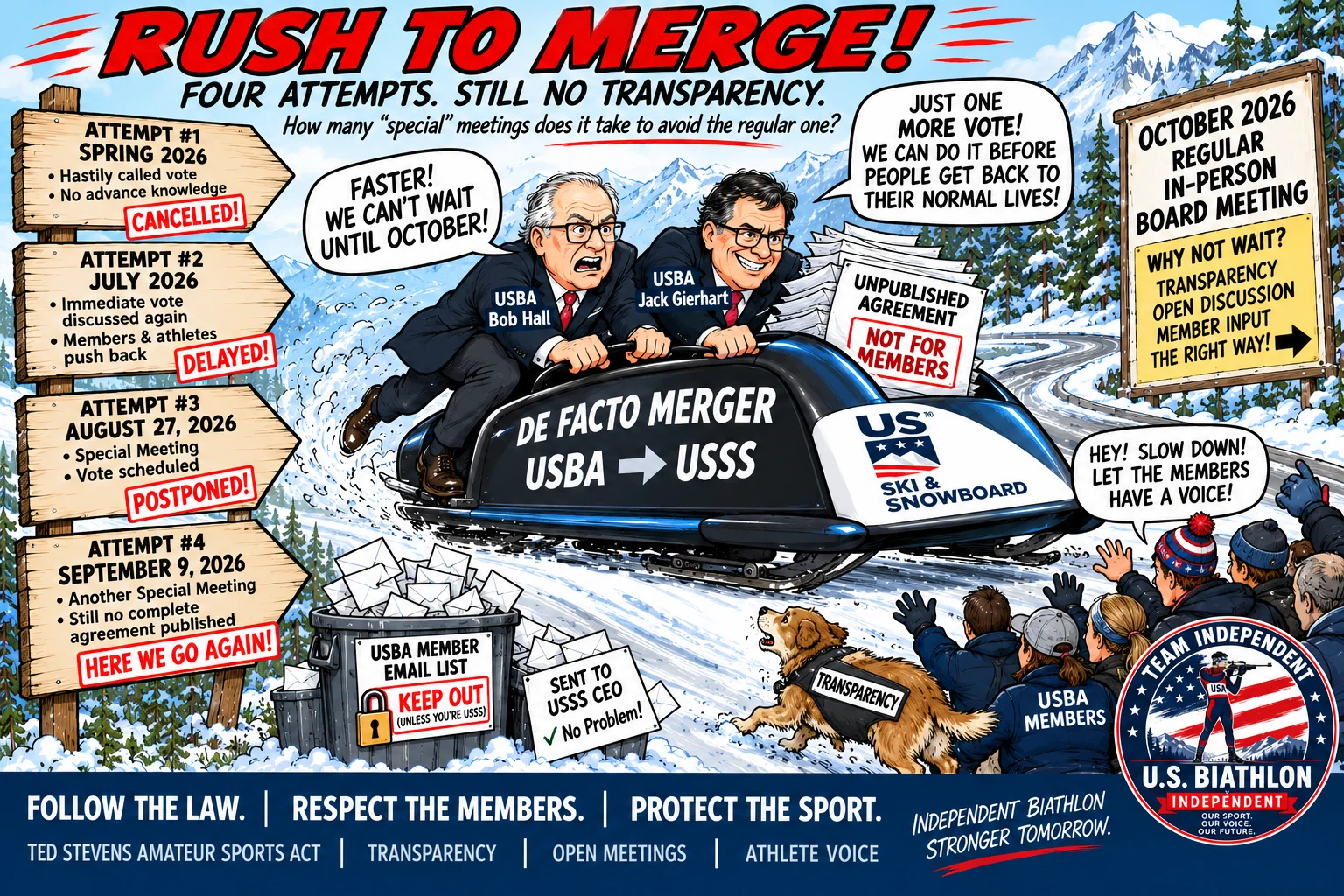
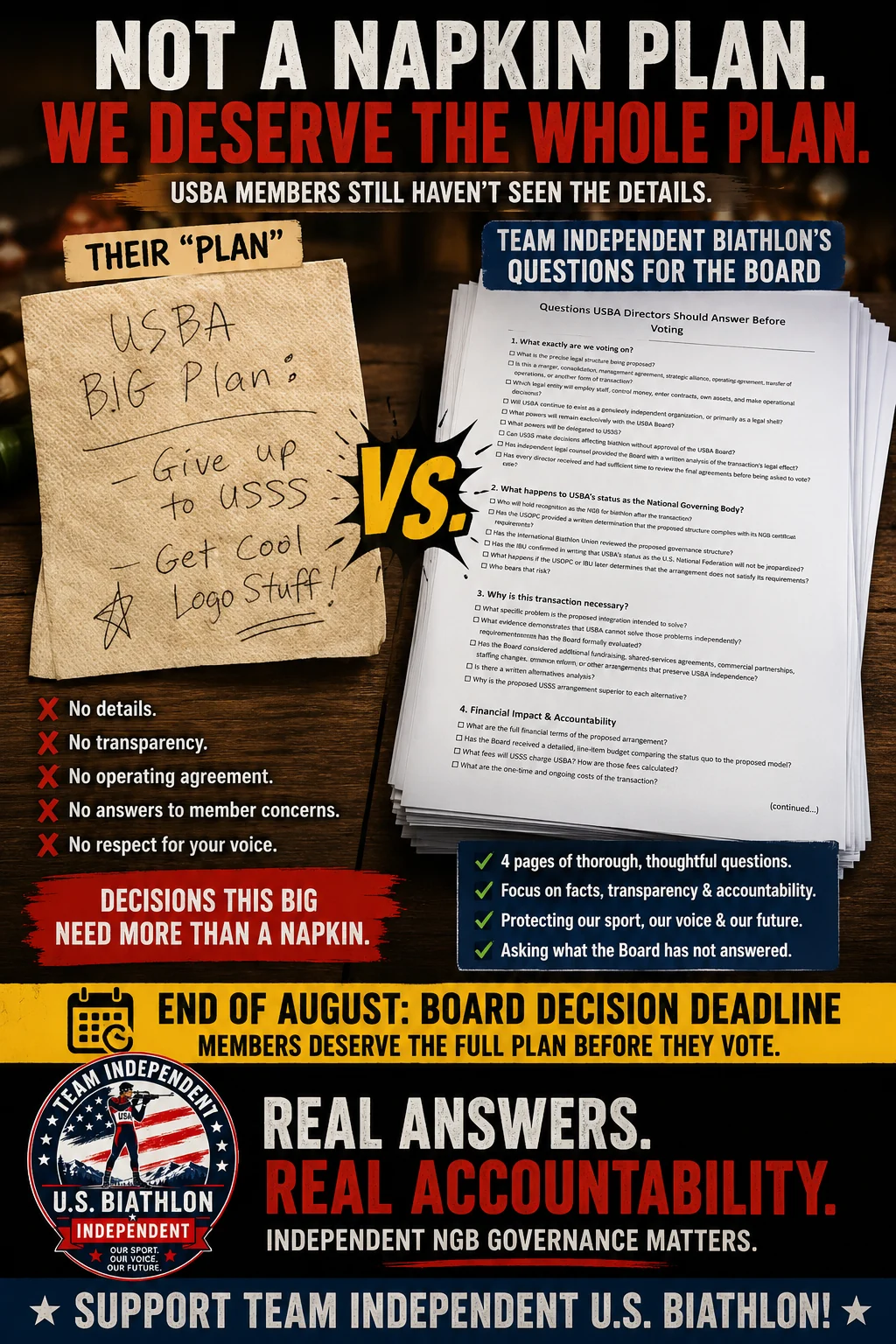
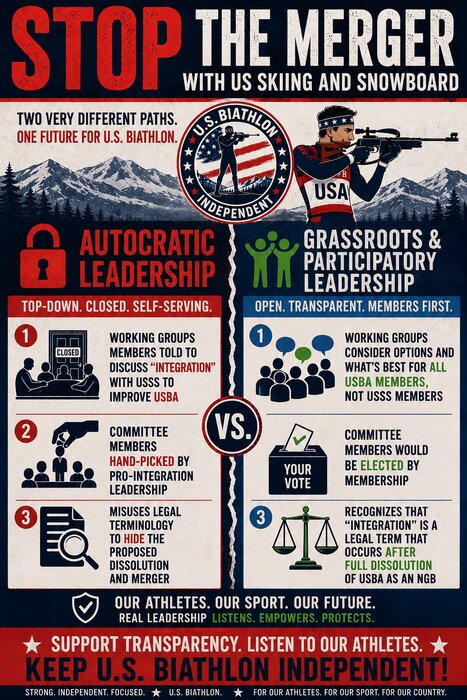
In response to pushback from USBA membership over the proposed merger and concerns about board transparency, U.S. Biathlon delayed its vote and announced, on July 10, 2026, that it is forming three "integration working groups" with USSS: High Performance and Athlete Success, Sport Development, and Governance/Biathlon Voice. USBA also launched an Integration Information page with FAQs for the community.
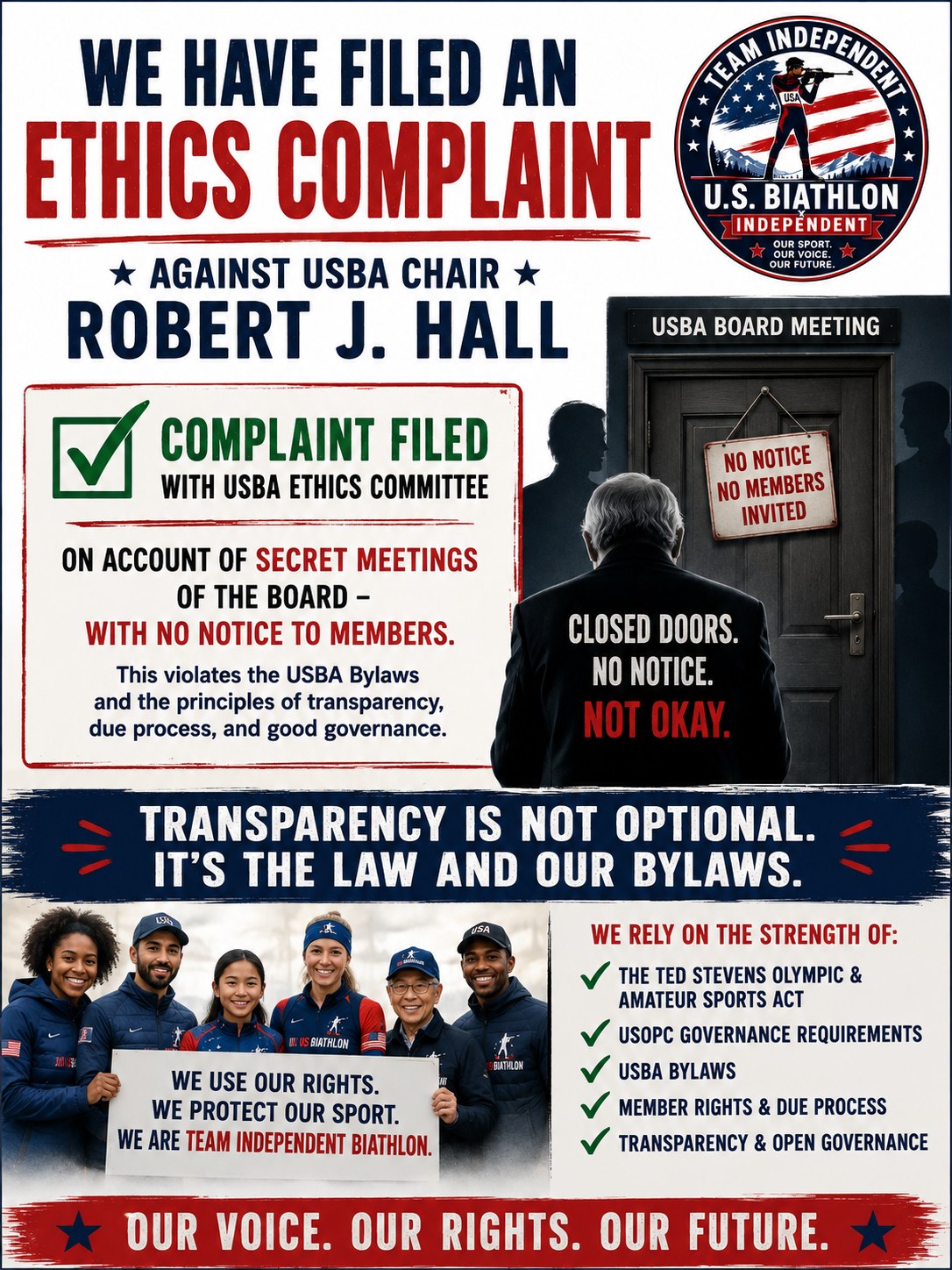
While the delay and working groups are a response to community pushback, Team Independent Biathlon remains concerned that leadership's underlying goal is still to dissolve USBA's independent NGB status, and that the working group members were hand-picked by leadership rather than elected or nominated through USBA's normal governance process.
Read the full announcement and working group rosters — US Biathlon
The concerns of Team Independent Biathlon were reviewed by Ed Williams, an Olympic biathlete and an experienced commercial litigator with over thirty years of experience as a former Assistant United States Attorney and then a partner in large New York City law firms. Mr. Williams specializes in sports law, arbitrations, civil trials, and appeals, and has been active in sports law, principally sports on the Olympic program, for his entire legal career.
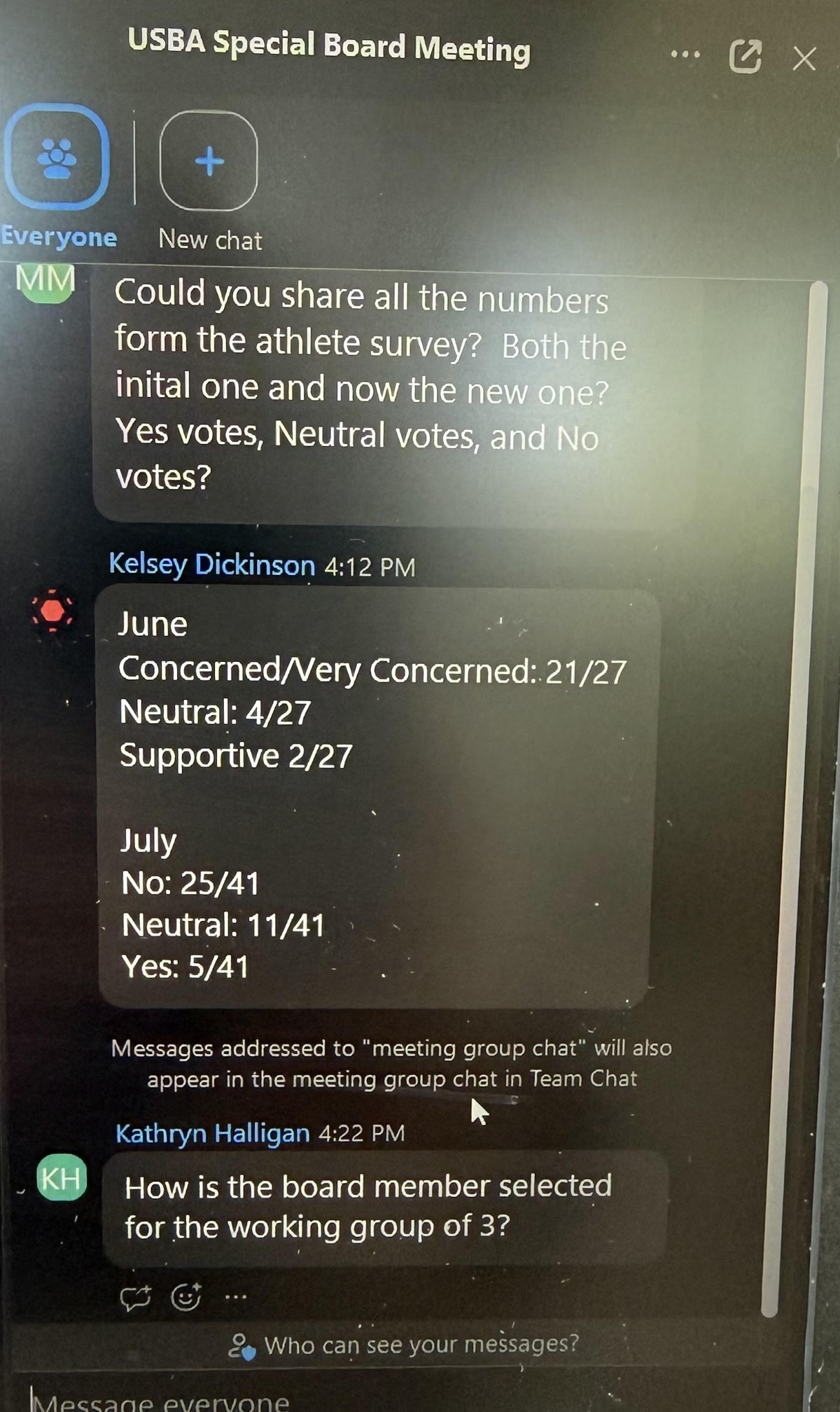
Ahead of the board's decision, USBA athletes were surveyed and gathered for a town hall to share their views on the proposed merger. Results below are from 27 athletes surveyed and the discussion that followed.
Athletes worry that stipends, performance bonuses, race expense coverage, and youth/junior camp budgets could be cut once initial funding protections expire, pointing to USSS's cross-country athletes — many unpaid — as a cautionary comparison. At the town hall, USSS leadership committed to ring-fencing existing funding and adding roughly $500K in year one, but athletes pushed back that a verbal commitment isn't enough without a binding agreement.
"The amount of support and funding that USBA provides to its developing athletes right now is vital. Without that support, I'm unsure how many of our current Youth and Junior athletes would be able to continue at the level that they do." — Survey respondent, JNT athlete
Nordic combined and ski jumping are frequently cited as examples of smaller Nordic sports being sidelined under USSS. Athletes are concerned that a several-year protection window is mismatched with the decade-plus timeline biathletes typically need to develop internationally competitive results.
"What happened to Nordic combined and smaller Nordic sports under the USSS umbrella should be an enormous red flag." — Survey respondent
Athletes fear biathlon's interests could get diluted inside a larger, multi-sport organization, and many felt the timeline for the board's decision didn't leave enough room for a change of this magnitude to be properly considered.
"My worry is that with a merger, the concerns of biathlon will just get muddled in with the plethora of other sports, and decisions will be made by people who don't have the best interest of biathlon as a singular sport." — Survey respondent
Many athletes said they don't understand what USBA stands to gain that it couldn't pursue independently, or what's actually motivating the arrangement from USSS's side.
"Is it a collaboration? Merger? Absorption? Will USBA and the members and athletes be able to keep the USBA identity, or are we just handing over our operational freedom for quick money and a temporary fix?" — Survey respondent
Athletes questioned whether the USBA board, once folded into USSS as a sport committee, would retain real binding authority or become purely advisory — with biathlon-specific decisions ultimately subject to override.
"USSS is a medals and money focused org, not a team, athlete, and integrity focused org. Any protections should not be trusted." — Survey respondent
IBU World Cup fields differ significantly in size from FIS Nordic fields, and athletes worry that performance standards built for cross-country wouldn't translate fairly, with no USSS equivalent to biathlon's development circuit.
Athletes described USBA's current culture as team- and integrity-focused, in contrast to what they see as a more medals-and-revenue-driven orientation at USSS, and flagged existing tension between dedicated biathletes and cross-over athletes as something a merger could deepen.
Junior national team athletes praised USBA's current youth programming for its individualized, development-focused approach, and worried a merger could shift toward a more generic, time-trial-based model.
"All three of my years at these championships, I have come home with pages of notes of things to work on. When I talk with my peers who go to USSS camps, they do more time trials and speed work, but don't learn nearly as much." — Survey respondent, JNT athlete
To the US Biathlon Board of Directors,
Thank you for the time, care, and dedication you have invested in supporting US Biathlon. We recognize the significant commitment required to sustain our organization and develop the sport in the United States. Your support makes our success possible and your efforts are sincerely appreciated by athletes.
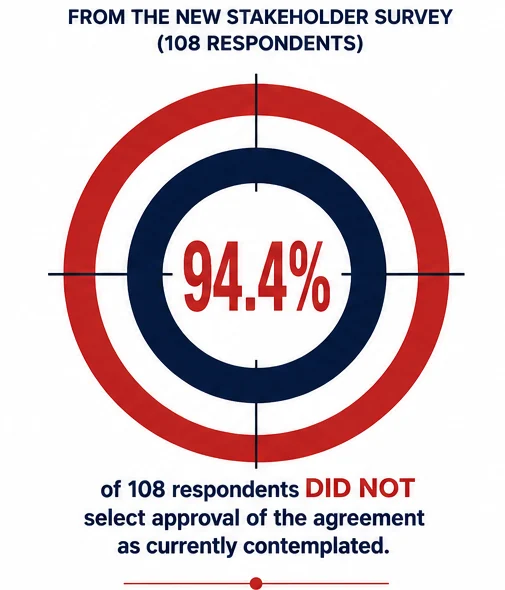
It is because we share your commitment to the long-term success of biathlon that we feel it is imperative to approach the proposed merge with US Ski & Snowboard thoughtfully, carefully, and with the athlete voice in mind. Athlete feedback regarding the proposed merge has been remarkably consistent since athletes were first notified of the proposal three weeks ago. Across surveys, town halls, and conversations, athletes have expressed significant concern regarding the current terms of the merge agreement. In a survey of top US senior and junior biathletes, 93% of respondents indicated they were concerned or fully opposed to the merge.
The strongest concerns raised by athletes relate to long-term athlete support and funding stability, athlete voice in governance, and the preservation of US Biathlon's culture and identity within a much larger organization. Underlying these concerns is a fear of loss in organizational priority. Currently, our independence protects US Biathlon since organizational leadership is singularly focused on our sport and puts our pursuit of success in biathlon above all else. Athletes have repeatedly cited examples from other smaller sports within US Ski & Snowboard where support, visibility, and influence diminished over time and many athletes believe US Biathlon would succumb to a similar fate should the merge proceed. These fears are justified as the current terms of the merge agreement commit to maintaining current levels of athlete support for only four years.
The conversation surrounding the merge has been heavily centered around funding. While important, funding should not be the only motivator of this decision, and it is essential to do our due diligence by considering other possibilities for addressing funding concerns within the organization. The mission of US Biathlon includes the objectives of growing the biathlon community in the US, developing athletes with integrity, and achieving international and Olympic success. Nesting our sport within a non-specific biathlon organization would fail to preserve our commitment to prioritizing success in biathlon and impede our ability to achieve success on the international stage. Forcing a merge without the support of the biathlon community would demonstrate a lack of integrity. Community input, independence, and autonomy are foundational in driving progress within our organization. Our NGB should be highly responsive to the needs of the athletes and the challenges specific to our sport, which a large conglomerate like USSS would be unable to do.
Given these concerns, we respectfully request that members of the Board of Directors vote NO to the proposed merge, in alignment with the athlete position. In its current form, the proposed merge agreement fails to address major concerns raised by the US Biathlon community and lacks clarity surrounding future governance, funding protections, and organizational structure. We recommend, at a minimum, slowing the timeline of any final decision until these details are better understood and direct athlete feedback is incorporated into the terms of the agreement. Additional time would also allow for an exploration of alternative pathways that could strengthen US Biathlon while preserving our independence and identity.
The level of athlete feedback and engagement throughout this process reflects how deeply athletes care about this organization. We value what has been built within US Biathlon and want to protect the aspects of the organization that are working well while also considering opportunities for growth. We are sharing the athlete perspective respectfully. Our intention is not to resist change for the sake of resisting change, but to advocate for the long-term health of the sport and ensure the athlete voice is considered in such a significant proposed change for the organization.
Thank you for your time, your service to the sport, and your willingness to listen to athlete perspectives. We look forward to collaborating with you to continue to strengthen our organization and achieve success at the highest levels of biathlon competition.
Sincerely,
US Biathlon AAC Athlete Representatives
The Case for Transparency in the USA Biathlon-USSS Integration Talks — FasterSkier
This article gives an overview of the USSS merger attempt.
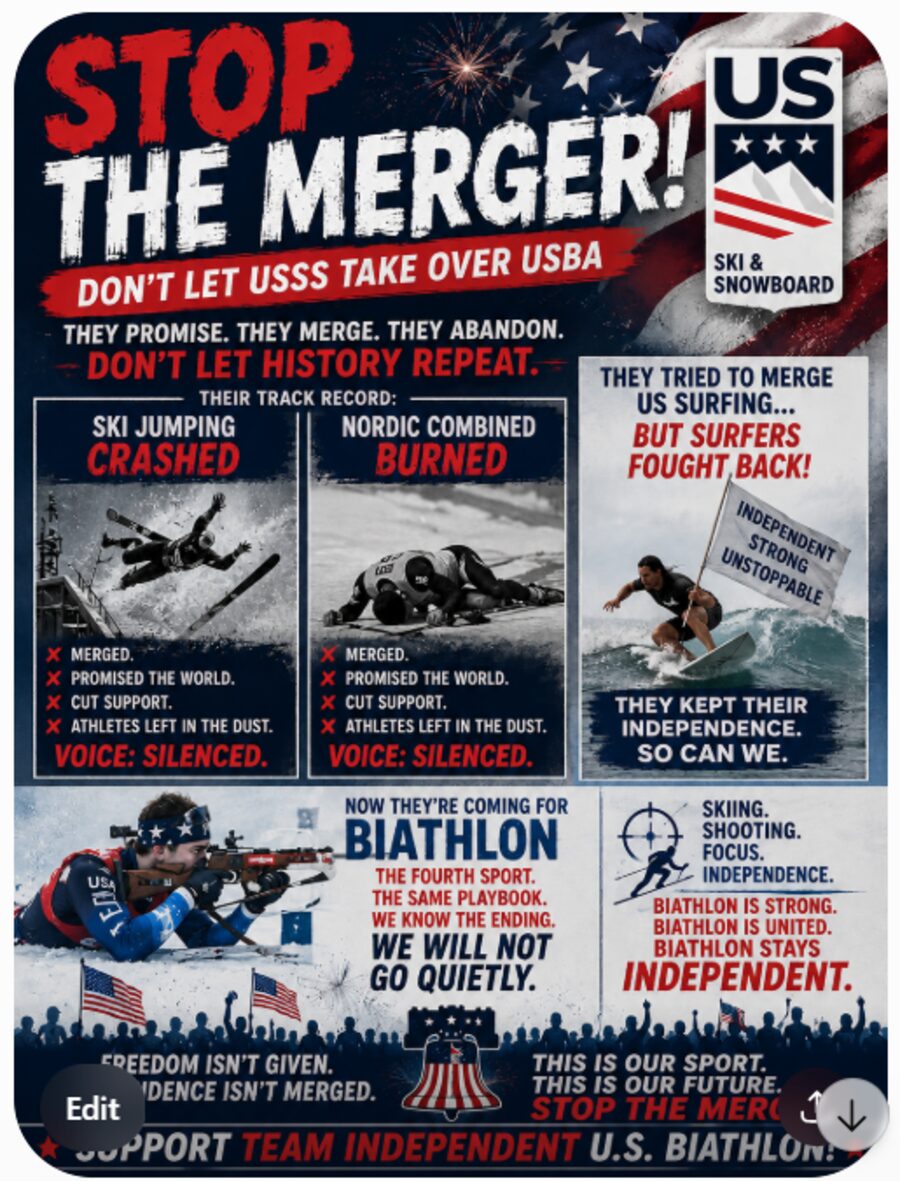
Notably, the article points out that in 2007, USSS (then the U.S. Ski Association) eliminated direct national team funding for Ski Jumping and Nordic Combined, citing financial sustainability concerns, and told those sports they would need to develop independent fundraising and governance models on their own. The author questions why USSS would now be willing to absorb another financially struggling discipline in biathlon when it had previously decentralized support for smaller Nordic sports on similar financial grounds.
In early 2025, U.S. Ski & Snowboard applied to become the National Governing Body for Olympic surfing, seeking to take over from USA Surfing. Surfers and industry leaders pushed back immediately, arguing that USSS lacked the coaching infrastructure, athlete pipeline, and cultural understanding of the sport — and that the Ted Stevens Olympic & Amateur Sports Act prohibits a National Governing Body from being recognized by two different international sports federations at once. USSS is already a member of the International Ski & Snowboard Federation, which made its bid legally questionable from the start.
After a year of public dispute, USSS formally withdrew its bid in November 2025, citing a breakdown in constructive dialogue with USA Surfing and choosing to redirect its focus to the upcoming Winter Olympic cycle. In April 2026, USA Surfing was formally certified by the USOPC as the sport's NGB, effective June 1, 2026 — confirming that USSS's bid ultimately did not succeed.
USSS has not stepped back from expanding its reach, however: reporting confirms it is still actively pursuing recognition as the National Governing Body for Olympic skateboarding, which has also lacked a certified NGB since the Tokyo 2020 Games. Notably, USSS's president and CEO, Sophie Goldschmidt, previously led the World Surf League herself — and coverage of the surfing dispute has framed USSS's ambitions as a broader push to build a multi-sport consortium under its umbrella. Between surfing, skateboarding, and the proposed biathlon merger, this points to a pattern of USSS seeking to absorb additional Olympic sports, not an isolated proposal specific to biathlon.
Reporting from Sportico in January 2026 confirms this directly from Goldschmidt herself: both the surfing and skateboarding applications were part of her stated goal of building what she called a "more central action sports" governing body, which she said could maximize commercial opportunities and fundraising. She also confirmed she remains open to revisiting the surfing takeover in the future. For scale, USSS reported $131.2 million in revenue over a recent four-year period — more than 36 times USA Surfing's $3.6 million over the same span — underscoring the financial gap that any absorbed sport, including biathlon, would be stepping into.
This is directly relevant here: the same Ted Stevens Act provision that helped sink USSS's surfing bid — a single NGB may not be recognized by more than one Olympic-affiliated international federation — applies with equal force to a proposed USSS-USBA merger, given USSS's existing membership in the International Ski & Snowboard Federation and biathlon's governance under the International Biathlon Union.
Sources: The Sports Examiner, Ski Racing, The Inertia, SGB Media, Snowsports News, SurferToday, Sportico, The Inertia (skateboarding), Stab Magazine
Looking at USSS's history with smaller Olympic sports side by side, biathlon isn't an isolated case — it's the latest step in a longer-running pattern.
| Sport | Status | Outcome |
|---|---|---|
| Ski Jumping | Under USSS | Direct national team funding eliminated in 2007, citing financial sustainability. |
| Nordic Combined | Under USSS | Same 2007 funding elimination; the sport has continued to struggle for support since. |
| Freeride Skiing & Snowboarding | Added 2026 | Brought in as a new USSS discipline in 2026 ahead of freeride's 2030 Olympic debut — expanding USSS's footprint further. |
| U.S. Surfing | Bid failed | USSS withdrew its takeover bid in November 2025; USA Surfing was certified as NGB by the USOPC in 2026. |
| Biathlon (USBA) | Actively pursuing | This is what Team Independent Biathlon is working to stop. |
| Skateboarding | Actively pursuing | USSS has an open application to become skateboarding's NGB, as of 2026 reporting. |
USSS's own language shows exactly how it treats sports once they're inside its umbrella.
That's the same fate a merger would hand to biathlon: folded in as one more "discipline" under a single, non-specific umbrella organization, rather than governed by a National Governing Body dedicated entirely to biathlon's athletes, culture, and future — which is exactly what the Ted Stevens Act requires for an independent Olympic sport.
Historically, NGBs have governed sports from the grassroots to the Olympic podium. U.S. Ski and Snowboard's approach would see the NGB taking on the elite teams in sports but leaving the rest of the pipeline to others to run.
"They do not understand that Federal Law (i.e., Section 220522(6) of the Sports Act)
prohibits (repeat, "prohibits") the "merger" which USSS's Sophie Goldschmidt and USBA's
Board Chair are proposing.
There is nothing to debate.
No amount of "pros" can trump Federal Law."
Help spread the word by adding this badge to your social media profile and posting it to your feed or story.
Join Team Independent Biathlon to help keep biathlon independent and support a member-led future.
Share your thoughts, ask questions, or connect with other biathletes and supporters below. This discussion is open to the public.